TL;DR: The Quick Summary Norwood Stage 4 is a significant level of male pattern baldness where hair loss occurs in two distinct areas: a deeply receding front hairline and a noticeable bald spot on the crown (vertex). Crucially, these two areas are still separated by a “bridge” of hair across the middle of the scalp. For most men, this is the “tipping point” where surgery becomes the only effective solution. A hair transplant for Norwood 4 typically requires 3,000 to 4,000 grafts to restore a youthful frame to the face and fill the thinning crown.
What is Norwood Stage 4?
Norwood 4 is characterized by advanced thinning at both the front and the back of the head, but the hair loss has not yet merged into one large bald area.
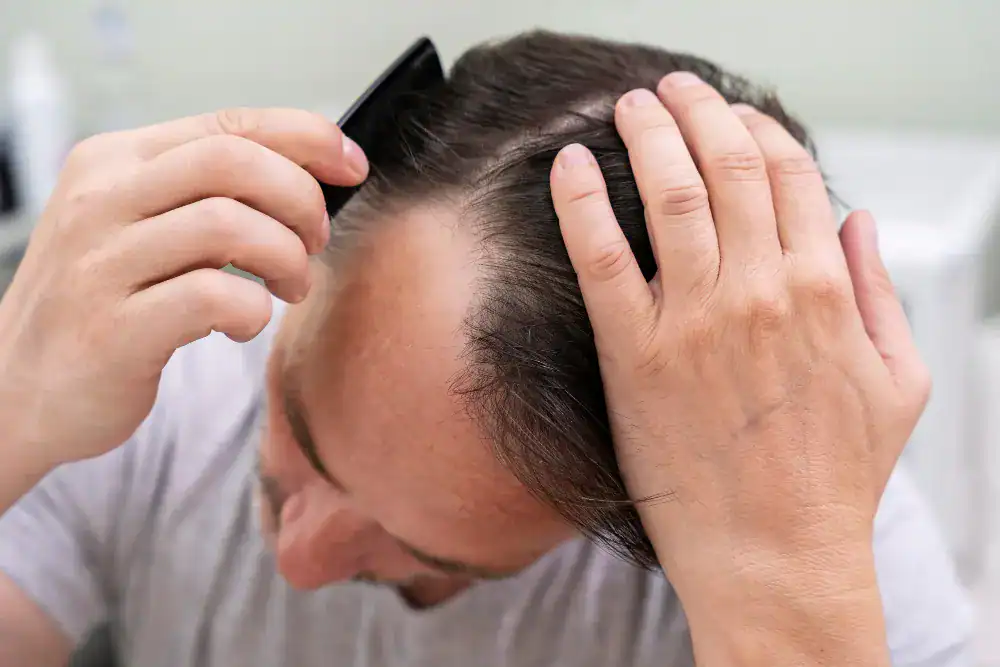
The Visual Landmarks: Receding Front and Balding Vertex
At this stage, you will notice three specific changes:
- Deep Frontal Recession: The “M” shape from earlier stages has deepened significantly. The hairline has moved further back toward the middle of the head.
- The Vertex (Crown) Bald Spot: A circular bald patch is clearly visible on the top-back of the head. This spot is often larger than a coin and can no longer be covered by styling.
- Thinning Mid-Scalp: Even where hair remains, the density is often noticeably lower than it was a few years ago.
The “Bridge”: Why This Hair Band is Critical
The defining feature of Stage 4 is the solid band of hair that runs across the top of the head, separating the frontal baldness from the crown baldness.
- Why it matters: As long as this bridge exists, you still have a “structured” look. If this bridge thins out or disappears, you progress to Stage 5 or 6, where the bald area becomes much larger and harder to fill with a single surgery.
- The Goal: One of the main objectives of treating Norwood 4 is to reinforce this bridge and ensure it doesn’t vanish.
How Many Grafts Are Needed for Norwood 4?
To achieve satisfactory density in both the hairline and the crown, most Norwood 4 patients require between 3,000 and 4,000 grafts.
Calculating the Area: Frontal vs. Crown Demand
A Norwood 4 transplant is essentially two procedures in one:
- Frontal Restoration (2,000 – 2,500 grafts): This is used to rebuild the hairline and fill the temples. This is the priority because it frames your face.
- Crown Filling (1,000 – 1,500 grafts): This is used to close the “hole” at the back. Because the crown is a circular area that grows in a whorl pattern, it often requires a surprising number of grafts to look dense.
Why a “Mega-Session” Might Be Necessary
Since the total graft count often exceeds 3,500, Medifue specialists often recommend a Mega-Session. Using Sapphire FUE or a Hybrid (FUE+DHI) technique, we can transplant a high volume of grafts in a single long session (6-8 hours), allowing the patient to recover from both areas simultaneously.
Hair Transplant Strategies for Norwood 4
Direct Answer: The biggest challenge in Stage 4 is managing the available donor hair to cover two large areas (front and crown). The most successful strategy is the “Front-First” approach, ensuring the face is framed perfectly while providing natural coverage for the vertex.
FUE vs. DHI: Which One for Combined Front and Crown Work?
For a Norwood 4 patient, a Hybrid Technique is often the gold standard:
- Sapphire FUE for the Crown: This allows for opening a large number of channels in the circular vertex area quickly, providing a wide area of coverage.
- DHI (Direct Hair Implantation) for the Hairline: This provides the highest precision for the front. Since DHI allows for controlled angle and direction, it is used to create a dense, natural-looking hairline that “frames” the face.
Prioritizing the Hairline: The “Face-Framing” Rule
In hair restoration, we follow a simple rule: The front is for others to see, the crown is for you to see. * Because your donor area (the back of your head) has a limited number of follicles, we always prioritize the frontal hairline.
- If we were to use all the grafts on the crown and leave the front thin, you would still look “bald” in the mirror and in photos. A strong, dense hairline creates the most dramatic visual “transformation.”
Managing the Crown: Why It Needs Extra Care
The crown (vertex) is often the trickiest part of a Stage 4 transplant for two reasons:
- The Whorl Pattern: Hair at the crown grows in a spiral. The surgeon must mimic this natural “tornado” direction, or the result will look like a “doll’s head.”
- Blood Supply: The scalp at the very top-back of the head has slightly less blood circulation than the front. This means crown grafts may take a few months longer (up to 14-18 months) to reach full thickness compared to the front.
Can You Reverse Norwood 4 Without Surgery?
Direct Answer: No. Once you have reached a visible Norwood 4 with smooth bald patches, non-surgical treatments cannot regrow the hair. However, they are still vital for protecting the “Bridge.”
The Limits of Minoxidil and Finasteride at This Stage
At Stage 4, medications like Finasteride or Minoxidil are used as maintenance, not as a cure.
- They can thicken the thinning hair in your “bridge” area and prevent you from sliding into Stage 5 or 6.
- They cannot recreate a hairline that has already disappeared.
Post-Op Support: Keeping Your “Native Bridge” Strong
Even after a successful 4,000-graft transplant, your original, non-transplanted hair in the middle of your head is still susceptible to genetic loss.
- The Danger: If you get a transplant but don’t use preventative care, you might keep your “new” front and crown, but lose the “old” hair in the middle, creating a strange “empty gap” over time.
- The Solution: Post-op PRP sessions and continued use of hair-strengthening vitamins are highly recommended for Norwood 4 patients.
Here is Part 3, the final section of the guide on Norwood 4.
This section focuses on managing expectations-since this stage involves the crown-and providing the necessary reassurance for patients about to undergo a significant transformation.
Frequently Asked Questions (FAQ)
Direct Answer: Patients at Stage 4 often worry about the “completeness” of their result because the area of loss is larger. Here are the most common questions we answer at Medifue.
Can one session cover the entire bald area in Stage 4?
Yes, in most cases. Because Norwood 4 still features a “bridge” of hair, the total bald area is divided into two smaller sections. A “Mega-Session” of 3,500 to 4,000 grafts is usually sufficient to provide dense coverage for the hairline and moderate-to-high density for the crown in a single day.
Will my crown look as thick as my hairline after surgery?
It depends on your donor capacity. As a rule, surgeons prioritize the hairline for visual impact. While we aim for maximum density in the crown, the “crown whorl” (the spiral pattern) naturally reveals more scalp than the forward-laying hair in the front. However, the result will look like a full head of hair to the casual observer.
Is Norwood 4 considered “advanced” hair loss?
It is considered the transition from “Moderate” to “Advanced.” It is the last stage where a single surgery can typically “fix” the entire problem. Once you progress to Stage 5 or 6, the bridge disappears, and the demand for grafts often exceeds what can be safely taken in one session.
How long is the recovery for a 4,000-graft session?
The physical healing (scabbing and redness) takes about 10 to 14 days. However, because Norwood 4 involves the crown, you must be extra careful with your sleeping position for the first week to avoid rubbing the transplanted grafts in the back against your pillow.
Conclusion: Why Stage 4 is the Best Time to Act
If you are at Norwood Stage 4, you are at a crossroads. You still have enough donor hair to achieve a total transformation, and you still have a “bridge” to work with.
The Medifue Advantage for Norwood 4: By using 3D Hair Planning, we can precisely calculate how many grafts to allocate to your receding front and how many to save for your balding vertex. This ensures that you don’t just “get hair,” but you get a balanced, age-appropriate, and dense result that looks natural from every angle.
Don’t wait for the bridge to collapse. Restoring a Norwood 4 head of hair is one of the most rewarding procedures in modern hair transplantation, offering a complete return to a youthful silhouette.