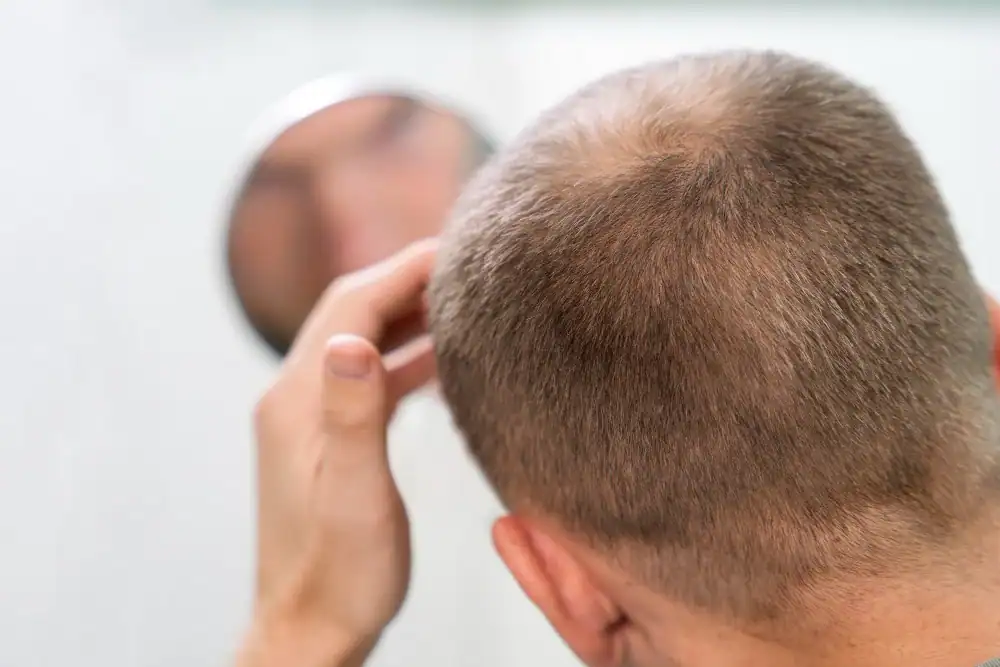
Shock loss (or the “shedding phase”) is a temporary and completely normal biological response experienced by approximately 95% of hair transplant patients. It typically begins 2 to 4 weeks after surgery and involves the shedding of hair shafts due to the natural trauma of the procedure. Do not panic: losing these hairs does not mean the transplant failed. The living follicles (roots) remain safely anchored under your skin. This phase usually ends by the 3rd or 4th month, after which permanent, healthy hair growth begins. It is simply a “reset” button for your hair cycle before the final results appear.
What is Shock Loss (Shedding Phase)?
Shock loss is the temporary shedding of hair shafts (the visible part of the hair) following a traumatic event to the scalp, such as a hair transplant. It occurs because the hair follicles enter a resting phase to protect themselves and recover.
The Science Behind It: Telogen Effluvium Explained
To understand shock loss, you must understand the hair growth cycle. Normally, your hair goes through three stages:
- Anagen: Growth phase.
- Catagen: Transition phase.
- Telogen: Resting phase (followed by shedding).
During a hair transplant (whether FUE or DHI), the extraction and implantation processes cause “micro-trauma” to the scalp. This sudden stress pushes the hair follicles out of the growing phase (Anagen) and forces them prematurely into the resting phase (Telogen). This condition is medically known as Telogen Effluvium.
Is Shock Loss Normal or a Sign of Failure?
It is 100% normal. In fact, approximately 90% to 95% of all hair transplant patients experience some degree of shock loss. It is not a sign of failure. On the contrary, it indicates that the body is reacting naturally to the procedure and the healing process has begun. The body sheds the old hair shaft to make room for a new, healthier hair strand that will grow from the same root.
The Difference Between Shedding Hair Shafts and Losing Roots
This is the most critical distinction every patient must understand:
- The Shaft: This is the visible strand of hair above the skin. This is what falls out.
- The Root (Graft): This is the living organ implanted under your skin. This remains safely in place.
Think of it like a tree in winter. The tree loses its leaves (the hair shafts) due to the change in season (the surgery trauma), but the roots remain alive underground. Come spring (the regrowth phase), new leaves will appear. Important Note: You might see a small white bulb at the end of the fallen hair. Do not worry; this is usually just dry skin or the anchor of the hair shaft, not the living graft itself.
When Does Shock Loss Start and End? (Timeline)
Shock loss typically begins between Week 2 and Week 4 after the surgery. It peaks around Month 2 and usually resolves by Month 3 or 4, after which permanent growth begins.
The First 2 Weeks: The “Honeymoon” Phase
Immediately after your transplant, your hair will look great. The implanted grafts are in place, and you can see your new hairline. We call this the “honeymoon phase.” During this time, the grafts are anchoring themselves into the recipient area.
Weeks 3 to 8: The Peak of Shedding
Around the third week, the shedding begins. It can be gradual or sudden. You may notice hairs falling out while washing or touching your head.
- By the end of Month 2, your recipient area might look thin or patchy.
- You may look like you did before the surgery. This is psychologically the hardest part of the process, often called the “Ugly Duckling” phase.
When Will My Hair Start Growing Back?
Once the shock loss phase ends (usually around the 3rd or 4th month), the follicles wake up from their rest. You will start to see thin, baby hairs emerging.
- Month 4-6: Significant regrowth becomes visible.
- Month 12: You will see the full density and final result.
Types of Shock Loss: Where Does It Happen?
Shock loss is not limited to the newly transplanted hair. It can occur in three distinct areas: the recipient area (transplanted hair), the surrounding existing hair (native hair), and rarely, the donor area (back of the head).
Shock Loss of Transplanted Hair (Recipient Area)
This is the most common form of shedding. As discussed in Part 1, the hair follicles that were moved from the back of your head to the top fall out due to the interruption in their blood supply during the transfer.
- Is it permanent? No.
- What happens next? The roots remain, rest for a few months, and then produce new hair.
Shock Loss of Native Hair (Existing Hair)
Patients often panic when they see their non-transplanted, existing hair thinning out around the implant area. This happens because the “neighborhood” has been disturbed. When new grafts are planted between existing hairs, the surrounding native follicles may also go into shock due to the inflammation and changes in local blood flow.
- Is it permanent? Usually, no. If the native hairs were healthy (not miniaturized), they will grow back. However, if the native hairs were already weak and nearing the end of their lifecycle due to genetic hair loss, the trauma of surgery might just accelerate their inevitable fall.
Shock Loss in the Donor Area (Back of Head)
This is less common but possible. It appears as temporary thinning or patchy areas in the back of the head where the grafts were taken.
- Why it happens: It is usually caused by “over-harvesting” (taking too many grafts from one spot) or excessive trauma during the extraction phase.
- Recovery: The donor area typically recovers faster than the recipient area as blood flow is stronger here. However, severe over-harvesting can lead to permanent patchy spots, which emphasizes the importance of choosing a skilled clinic like Medifue.
Why Does Shock Loss Happen? The Main Causes
Shock loss is primarily caused by trauma to the scalp and a temporary disruption of blood flow (vascularity). The body prioritizes healing the skin over growing hair, forcing follicles into a resting state.
Trauma to the Scalp and Reduced Blood Flow
Every incision or channel opened during a hair transplant (whether via Sapphire blade or DHI pen) creates a tiny wound. When thousands of these micro-wounds occur at once, the scalp experiences inflammation. To heal these wounds, the body redirects energy and blood flow to skin repair. The hair follicles, receiving fewer nutrients and oxygen for a short period, essentially “shut down” to survive the trauma.
The Impact of Anesthesia and Adrenaline
During the operation, a fluid mixture containing local anesthesia and adrenaline (tumescent fluid) is injected into the scalp.
- Adrenaline: It constricts blood vessels to minimize bleeding. While this is necessary for a clean surgery, it temporarily restricts blood flow to the hair roots, contributing to the “shock” effect.
- Fluid Pressure: The physical pressure of the fluid under the skin can also compress the follicles, triggering the resting phase.
High Density Packing (Dense Packing)
We all want high density, but there is a limit. If a surgeon packs grafts too closely together (“dense packing”), the blood supply in that specific square centimeter may not be enough to support all the roots immediately.
- The Risk: The competition for blood supply causes the follicles to shed their hair shafts quickly to conserve energy.
- The Balance: An experienced surgeon knows the optimal density to maximize results while minimizing trauma and shock loss.
Here is Part 3 of the comprehensive guide on Shock Loss. In this section, we move from the “Why” to the “How.” This is what users search for when they want to take control of the situation and speed up their recovery.
Can You Prevent or Minimize Shock Loss?
You cannot completely prevent shock loss, as it is a natural biological response to surgery. However, you can minimize its severity and speed up regrowth by improving blood circulation and providing the hair follicles with the right nutrients.
The Role of Medication (Minoxidil & Finasteride)
Many surgeons recommend specific medications to support the hair during this vulnerable period.
- Finasteride: This oral medication helps lower DHT levels (the hormone responsible for hair loss). It is particularly effective in preventing “shock loss of native hair” by strengthening existing weak follicles so they don’t fall out during the trauma of surgery.
- Minoxidil (Rogaine): Often prescribed 1 month after the transplant, this topical solution widens blood vessels (vasodilation), increasing blood flow to the scalp. This keeps follicles in the growth (Anagen) phase longer and can wake them up faster from the resting phase. > Note: Always consult your hair transplant surgeon before starting these medications, as timing is crucial.
Vitamin Supplements (Biotin and Multivitamins)
Hair needs “fuel” to rebuild.
- Biotin (Vitamin B7): Known as the “hair vitamin,” Biotin is essential for the production of keratin, the protein that makes up hair. Taking high-dose Biotin (often 5000mcg or 10000mcg) post-op is a standard recommendation.
- Zinc and Iron: Deficiencies in these minerals can prolong hair shedding. Ensuring your levels are normal helps the body focus on regrowth rather than survival.
PRP Therapy (Platelet-Rich Plasma)
PRP is one of the most effective ways to reduce the impact of shock loss.
- How it works: Your own blood is drawn, spun to concentrate the healing platelets, and injected back into the scalp.
- The Benefit: PRP is packed with growth factors that repair tissue and stimulate hair follicles. Doing a PRP session during or immediately after surgery can reduce inflammation and speed up the transition from the shedding phase back to the growth phase.
Importance of Gentle Washing and Massage
- Washing: Removing scabs correctly (usually around day 10-12) allows the skin to breathe. Scabs left too long can block pores and hinder new growth.
- Massage: Once the grafts are fully secure (usually after 1 month), gentle fingertip massage increases blood circulation to the scalp, which brings oxygen to the recovering follicles.
Myths vs. Facts About Post-Transplant Shedding
There is a lot of misinformation online that causes unnecessary anxiety. Let’s clear up the confusion with facts.
Myth: “If the hair falls out, the surgery failed.”
Fact: False. Shedding is a sign that the body is healing and the hair cycle is resetting. A failed transplant is determined by whether the roots survive, not whether the shafts stay attached. You cannot judge the success of a transplant until at least 12 months have passed.
Myth: “Shock loss is permanent.”
Fact: False. Shock loss caused by the trauma of surgery is temporary. The only time it might be permanent is if the native hair was already miniaturized and destined to fall out soon anyway (due to advanced genetic balding), or if the surgeon severely damaged the tissue (transection). In expert hands, shock loss is temporary.
Myth: “Everyone loses 100% of their transplanted hair.”
Fact: False. While most people lose about 80-90% of the transplanted hairs, some lucky patients (about 5-10%) experience very little shedding. This phenomenon involves the grafts continuing to grow without ever entering the resting phase, though this is rare. Here is Part 4, the final section of the comprehensive guide on Shock Loss. This section addresses the specific “high-volume” questions users type into Google and wraps up the article with a reassuring conclusion.
Frequently Asked Questions (FAQ)
Here are quick answers to the most common worries patients have during the shedding phase.
Does shock loss happen less in DHI or Sapphire FUE?
Technically, DHI (Direct Hair Implantation) and Sapphire FUE are designed to cause less tissue damage compared to older slit methods. Because Sapphire blades create smaller, smoother channels and DHI pens allow for implantation without pre-opening holes, the trauma to the scalp is reduced.
- The Verdict: While advanced techniques like those used at Medifue reduce trauma and potentially the duration of healing, they cannot completely stop the biological shock response. You should still expect shedding with DHI or Sapphire, but the recovery of the skin might be faster.
Can stress cause more shock loss?
Yes. Cortisol, the stress hormone, signals hair follicles to shift into the resting phase.
- The Advice: Post-operative anxiety is common (“Did I mess up?”, “Will it grow?”). However, stressing about the shedding can actually make the shedding worse. Trust the process, follow your doctor’s instructions, and try to relax during the recovery months.
I see a white bulb on the fallen hair. Did I lose the graft?
This is the #1 fear. When you see a hair in the sink, look closely.
- If it’s just a hair: It’s fine.
- If it has a white tip: It is still likely fine. That white tip is usually just the follicular sheath (dead skin tissue) or the anchor of the hair shaft.
- The Reality Check: For a graft (root) to fall out, there would usually be bleeding. If there is no blood, the root is safe under your skin.
Does wearing a hat affect the shedding phase?
Wearing a hat doesn’t directly cause shock loss, but friction can be harmful in the early days.
- Timeline: Avoid hats for the first 10-14 days until the grafts are anchored.
- After 2 weeks: You can wear a loose-fitting hat to hide the “shedding look,” but ensure it allows your scalp to breathe. Trapping heat and sweat excessively can create an unhealthy environment for the skin.
Conclusion: Patience is Key to the Final Result
Understanding shock loss is the best way to cope with it. It is not a complication; it is a physiological necessity. Your scalp needs to shed the old to build the new. Summary of the Journey:
- Surgery Day: The seeds are planted.
- Weeks 2-8 (Shock Loss): The winter comes. The leaves fall, but the roots remain alive.
- Months 3-4: Spring begins. Tiny sprouts appear.
- Months 6-12: Summer arrives. Full, permanent hair growth is visible.
If you are in the middle of the “Ugly Duckling” phase right now, look in the mirror and remember: This is temporary. The root is safe, the blood flow is returning, and your permanent hair is preparing to grow for a lifetime.