TL;DR: Most people lose 50–100 hairs per day, and that is completely normal. Only when the hair loss lasts for weeks, becomes significantly stronger or leads to visible thinning, a wider parting or a receding hairline, is it considered noticeable hair loss. Temporary factors such as stress, illness, hormonal changes or nutrient deficiencies can temporarily lead to increased hair loss and are often reversible. Real hair loss, on the other hand, shows changes in patterns and finer, weaker regrowing hairs. With simple self-tests you can clearly recognize the difference. If the hair loss lasts longer or gets worse, Medifue helps by means of precise analysis, individual treatment plans and modern treatments to find the cause and specifically support hair growth.
What actually counts as normal hair loss?
Normal hair loss means that a certain number of hairs fall out every day without the overall hair fullness visibly decreasing – a completely natural process in the hair cycle. Every hair has a limited lifespan and automatically falls out at the end of its growth phase. This is not a sign of disease, but a necessary step so that new hairs can grow back. As long as the number of hairs that fall out remains within the normal range and the scalp continues to produce new hairs, this is referred to as physiological, i.e. normal hair loss. Normal hair loss:
- does not lead to visible thinning
- affects the hair evenly across the entire head
- is part of the natural regeneration process
- occurs every day without you always noticing it
Only when the amount increases significantly or problems with density appear do we speak of noticeable hair loss.
How many hairs do you lose per day?
On average, a person loses about 50 to 100 hairs per day – and this is considered completely normal. However, this amount can vary slightly depending on the season, lifestyle, hormonal situation and hair length. Longer hairs often look more dramatic when they fall out because they are more noticeable visually, even though the number is no higher than for people with shorter hair. Typical reference values:
- 50–100 hairs per day: normal
- 100–150 hairs per day: still within range, e.g. with long hair or seasonal changes
- 150+ hairs daily over several weeks: potentially noticeable hair loss
- Sudden heavy hair loss in clumps: indication of telogen effluvium or a medical cause
Important: It is not the number of hairs that fall out that is decisive, but whether visibly less volume or new gaps appear.
Why do we lose hair at all?
We lose hair because every hair follicle goes through a natural growth cycle – and shedding is a planned, biological part of this cycle. Hair does not grow permanently. Each individual hair goes through phases of growth, transition and rest. Once a hair reaches the end of its life, it is shed by the follicle so that a new hair can grow. This process takes place in every person, every day.
The three phases of the hair cycle
1. Anagen phase (growth phase)
- lasts 2–6 years
- 85–90 percent of all hairs are in this phase at the same time
- the longer it lasts, the longer a hair can grow
2. Catagen phase (transition phase)
- lasts about 2–3 weeks
- the hair gradually detaches from the follicle
3. Telogen phase (resting phase)
- lasts 2–4 months
- at the end, the hair falls out
- a new hair is already beginning to grow underneath
However, if many hairs at the same time enter the telogen phase – for example due to stress, illness or hormonal changes – the hair loss suddenly appears much stronger, even though the biological mechanism is the same.
When is hair loss no longer normal?
Hair loss is no longer normal when the daily loss is clearly above average, lasts longer than several weeks or leads to visible thinning. While normal shedding does not cause any changes in the hair’s appearance, noticeable hair loss shows clear signs: the hair looks thinner, the parting becomes wider, the hairline recedes or certain areas visibly lose density. These changes indicate that the follicles themselves are affected – not just the hairs that fall out.
Warning signs of abnormal hair loss:
1. Visible thinning of the hair
If the volume noticeably decreases or the scalp shows through more, this is no longer normal shedding.
2. A widening parting
A gradually widening middle parting is a classic sign of early androgenetic hair loss – especially in women.
3. Receding hairline
In men, this usually affects the temples; in women, the fine frontal hairline.
4. Round or patchy bald spots
This may indicate alopecia areata or inflammatory scalp diseases.
5. Hair loss lasting more than 8–12 weeks
Normal, reactive shedding (e.g. after stress or illness) should subside. If not, there is usually more behind it.
6. Loss of very fine, miniaturized hairs
Thinner, weaker hairs indicate a change in the follicle, not normal shedding.
7. Negative changes without a clear trigger
If there was no obvious trigger such as stress, fever or dieting, medical causes are more likely. The earlier noticeable hair loss is recognized, the better the chances of treatment.
Which factors can temporarily trigger more hair loss?
Temporary increased hair loss occurs when an external or internal trigger pushes many hairs simultaneously into the resting (telogen) phase – a condition known as telogen effluvium. The hair roots are not permanently damaged, which is why the hair loss usually normalizes again within weeks or months. The crucial thing is to identify and eliminate the trigger.
Common short-term triggers for increased hair loss:
1. Stress and emotional strain
Severe psychological stress can push hair follicles prematurely into the resting phase. The hair loss typically appears 6–12 weeks later.
2. Hormonal changes
Particularly common:
- after pregnancy (postpartum hair loss)
- with menstrual or cycle changes
- during menopause
3. Illnesses and infections
Febrile illnesses, flu, Covid-19 and other infections are among the most frequent medical triggers of diffuse hair loss.
4. Changes in diet or deficiencies
Low levels of:
- Iron / ferritin
- Vitamin D
- Zinc
- Protein can disrupt the hair cycle.
5. Medications
Some medications can cause increased shedding, for example:
- Antidepressants
- Blood pressure medication
- Hormones
- Thyroid preparations
6. Weight loss or crash diets
Rapid weight loss throws the metabolism out of balance – and hair reacts particularly sensitively.
7. Change of seasons
Seasonal hair loss, especially in late summer and autumn, is very common and harmless. As long as the hair roots remain healthy, this hair loss is reversible.
Which signs indicate real hair loss rather than normal shedding?
Real hair loss is shown by visible changes in hairline, density and structure – in contrast to normal shedding, which leaves no long-term traces. Shedding means that hairs fall out but new hairs grow back with the same strength. In real hair loss, however, the follicle changes: it produces thinner, weaker hairs or stops production altogether. It is therefore important to recognize the subtle differences.
Signs of normal shedding (harmless):
- Hair loss is evenly distributed across the entire head
- No visible change in hair fullness
- The parting remains the same width
- The hairline does not change
- New short hairs grow back well
- Hair loss occurs for a limited period of time (weeks to a few months)
- A clear trigger is identifiable (stress, illness, dieting, childbirth etc.)
Signs of real hair loss (requires treatment):
1. Visible thinning of specific areas
For example at the crown, at the temples or along the parting.
2. Widening parting
A classic sign of female androgenetic hair loss.
3. Receding hairline
Especially in men, this is a sign of early genetic hair loss.
4. Miniaturized hairs
The hairs that grow back become finer, shorter and weaker – a typical sign of follicle changes.
5. No improvement over several months
If the hair loss does not decrease after 3–6 months, there is usually more behind it than normal shedding.
6. Round or patchy bald spots
This often indicates alopecia areata or inflammatory scalp diseases.
7. Hair loss occurs without a clear trigger
Without stress, illness or hormonal fluctuations, real hair loss is more likely. Early detection makes an enormous difference, because weakened follicles are easier to stabilize than those that are already inactive.
How can you observe and assess hair loss at home?
Hair loss can be assessed surprisingly well at home if you know what to look for – especially changes in density, structure and pattern, not just the amount of hair that has fallen out. The key is: do not count the hairs in the sink, but observe the development over weeks. With a few simple methods you can determine for yourself whether it is normal shedding or real hair loss.
1. Pull test
Take a small strand of hair and gently pull it.
- 1–3 hairs come out: normal
- 5 or more hairs repeatedly come out: possible increased hair loss
This test should only be carried out on dry, clean hair.
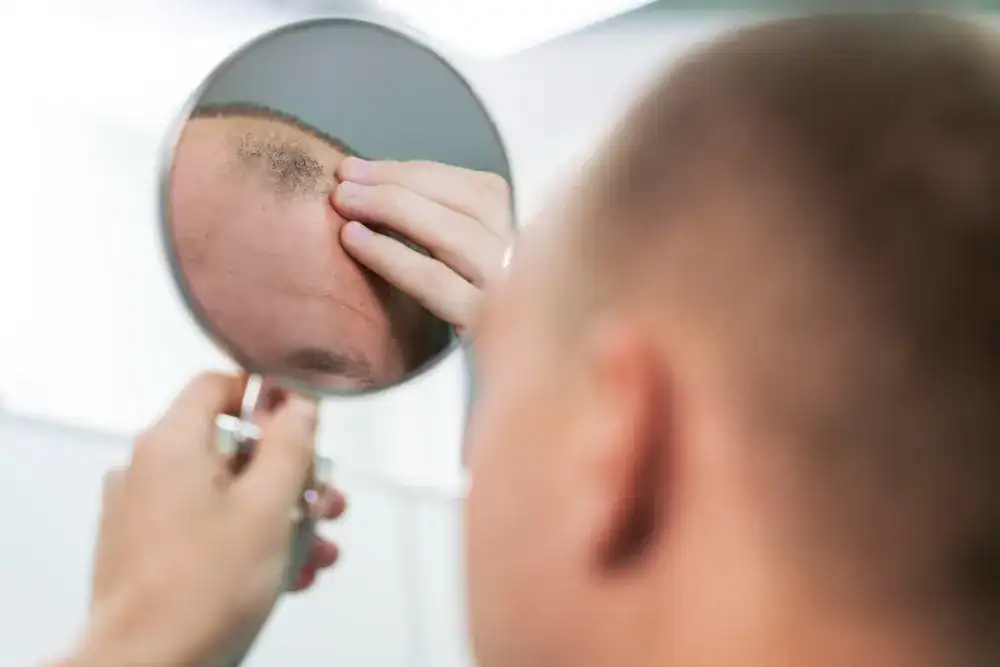
2. Mirror check of parting and hairline
Check once a week in the same light:
- Is the parting getting wider?
- Does the crown look thinner?
- Is the hairline slowly receding?
If so, this indicates real hair loss.
3. Photo comparison
Take photos of:
- Parting
- Crown
- Hairline
- Sides
Always under the same conditions (light, distance, angle). Photos show changes that remain unnoticed in everyday life.
4. Observe new growth
Healthy regrowing hair is:
- evenly distributed
- strong
- not extremely thin or colorless
Miniaturized hairs (thin, soft, short) indicate the beginning of follicle shrinkage.
5. Pay attention to triggers
If you have recently had stress, infections, dieting or hormonal changes, it is likely to be temporary shedding. If there is no trigger, chronic hair loss is more likely.
6. Observe the duration
- up to 12 weeks: often normal shedding
- longer than 3–6 months: take a closer look, often pathological
With these methods you can already assess quite well whether action is needed.
What can you do about excessive hair loss?
With excessive hair loss, the most helpful steps are to find the cause, stabilize the scalp and support the hair follicles in a targeted way – through proper care as well as medical approaches. Important: Most people react too late. The earlier you act, the better hair loss can be stopped or slowed down.
1. Optimize diet and nutrients
Hair follicles react extremely sensitively to deficiencies. Particularly important are:
- Iron / ferritin
- Vitamin D
- B vitamins (B7/biotin, B12)
- Zinc
- Protein
A blood test helps to find out whether there is a deficiency.
2. Reduce stress and improve sleep
Stress is one of the most common triggers of diffuse hair loss. Regular sleep, relaxation techniques and exercise help stabilize the hair cycle.
3. Gently care for the scalp
Particularly important in hair loss:
- mild shampoo
- no aggressive rubbing
- lukewarm water
- scalp serums with soothing or stimulating effects
A balanced scalp creates the best conditions for strong hair growth.
4. Avoid styling stress
- less heat
- no tightly tied hairstyles
- no aggressive chemical treatments
Less strain means less hair breakage – and this visibly improves hair density.
5. Use medical options when necessary
If real hair loss is present, the following treatments can help:
- Minoxidil to prolong the growth phase
- PRP treatment to stimulate the follicles
- Mesotherapy with growth factors and nutrients
- for hormonal hair loss → medical therapy
These methods target the follicles directly and support long-term growth.
6. Seek professional help early
You should not watch excessive hair loss for months. An expert can:
- analyze the hair type
- determine the cause
- create an individual treatment plan
Medical advice saves time and prevents follicles from being permanently damaged.
How Medifue supports noticeable hair loss
Medifue supports patients in identifying the actual causes of their hair loss and in developing an individually tailored treatment plan. As hair loss can have many forms and triggers, Medifue relies on precise analysis – because only when it is clear why the hair is falling out can the right therapy be chosen.
1. Detailed hair and scalp analysis
Medifue uses modern diagnostic methods to assess the following:
- Hair structure and density
- Signs of miniaturization
- Scalp condition, sebum production, inflammation
- Pattern of hair loss
This analysis clearly shows whether it is normal shedding, diffuse hair loss or early hereditary hair loss.
2. Individual medical treatment plan
Following the diagnosis, Medifue creates a tailored concept that may include:
- Optimization of nutrients
- Scalp care
- Medical lotions or tonics
- Lifestyle and stress management
Each plan is based on the individual situation and the stage of hair loss.
3. Non-surgical treatments for better hair growth
Medifue offers proven, gentle therapies, including:
- PRP (platelet-rich plasma) to activate the follicles
- Mesotherapy with regenerative active ingredients
- Medical scalp treatments
- Strengthening growth serums
These methods help to reactivate weakened follicles and support hair growth.
4. Hair transplantation in advanced hair loss
If the follicles are permanently damaged and no self-regeneration is possible, Medifue performs modern FUE hair transplants. The procedure is individually planned and provides:
- natural hairlines
- high graft survival rate
- gentle treatment
5. Long-term support and monitoring
Hair loss is a process – that is why Medifue supports patients in the long term in order to:
- stabilize results
- prevent renewed hair loss
- strengthen scalp health permanently
Medifue ensures that not only the symptoms but also the actual causes are treated.