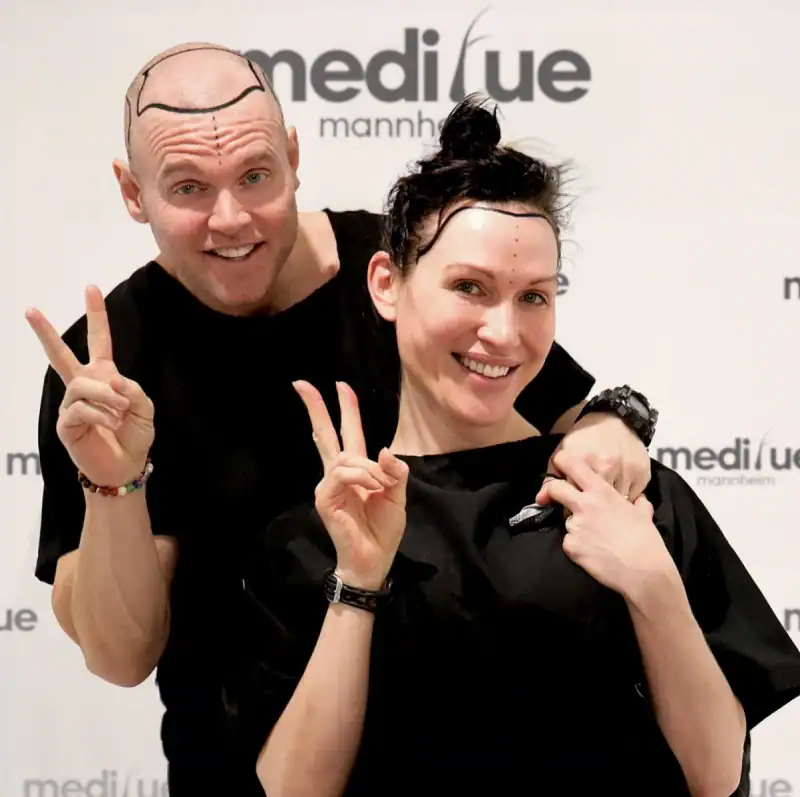
TL;DR: A hair transplant for women in Germany is a permanent solution against hair loss, especially in cases of diffuse thinning or a receding hairline. With modern methods such as FUE, Sapphire FUE or DHI, natural results without shaving can be achieved. Healing takes around two weeks, first results are visible after 3-4 months, and the final result after 12 months with denser, healthy and naturally growing hair.
Why women consider a hair transplant
Hair loss no longer affects only men; around 40% of all women experience visible hair loss over the course of their lives. Hormonal changes (e.g. after pregnancy or during menopause), stress, genetic predisposition or metabolic disorders can lead to diffuse thinning or bald patches.
Unlike men, women rarely lose all their hair, but rather density and volume in specific areas most often at the frontal hairline, the parting or the temples. A hair transplant offers a permanent solution here by transplanting healthy follicles from the back of the head into the affected areas.
💡Important:
For women, an accurate diagnosis is crucial only those who have a stable hair root structure benefit from the transplant in the long term.
How does a hair transplant for women work?
The process of a hair transplant in women differs slightly from that in men, as the goal is usually building volume and improving density rather than reconstructing a completely bald area. The procedure is minimally invasive, performed under local anesthesia and takes 4-8 hours, depending on the size of the area.
1. Hair analysis and planning
Before treatment, the scalp is examined using trichoscopy to determine hair density, thickness and donor quality. The doctor individually defines the hairline and transplantation zones.
2. Extraction of the grafts (donor area)
Healthy hair follicles are extracted from the back or sides of the head. Depending on the method:
- FUE (Follicular Unit Extraction) – individual follicles are removed with a micro punch
- Sapphire FUE in Germany – using fine sapphire blades for faster healing
- DHI (Direct Hair Implantation) in Germany – direct implantation with the Choi pen, without creating channels
3. Implantation into the recipient area
The follicles are placed precisely into the thinned areas, taking into account growth direction, depth and natural density. In women, the aim is an even, aesthetically pleasing distribution of volume.
4. Healing and growth phase
- After 3 days: first hair wash
- After 10 days: scabs fall off
- After 1-3 months: “shock loss” (temporary shedding of the transplanted hairs)
- After 6 months: visible hair growth
- After 12 months: full, permanent result
Hair transplant in women before and after example from practice
These before-and-after images show the natural course of a hair transplant in women from planning and the healing phase through to the final result after several months. The transformation illustrates how precisely a modern transplant can restore the hairline and create a harmonious overall appearance.

📍 Before (planning phase)
The first image shows the patient before the operation. The future hairline is marked to plan the shape and symmetry individually.

📍 Directly after the transplant (day 1)
The second image documents the condition immediately after the operation. The transplanted grafts are visible; the redness is part of the normal healing process.

📍 After several months (final result)
The third image shows the result after complete healing. The hairline looks natural, the volume has built up evenly and the patient shows significantly fuller, more harmonious hair.
💡Note: All results come from real treatments and show that a carefully planned hair transplant in women delivers permanently natural outcomes.
What results can be expected after a hair transplant in women?
A hair transplant in women delivers permanent and natural results when the procedure is carefully planned and professionally performed. The transplanted hair follicles come from the donor-resistant area at the back of the head and are therefore insensitive to hormonal hair loss.
The healing and growth process takes place in several clearly defined phases:
Growth progression after the hair transplant
| Month | Change | Description |
| 1-2 | Healing phase | Mild redness, scab formation, first new hairs visible |
| 3-4 | Shock loss phase | Transplanted hairs shed temporarily (normal cycle) |
| 5-6 | First results | New hairs grow back finer and evenly |
| 7-9 | Density build-up | Visible thickening, more even growth |
| 10-12 | Final result | Full volume, stable hairline, permanent outcome |
Success rate and permanence
- Growth rate: 90-95% of the transplanted grafts grow permanently
- Permanence: Lifelong, as donor hairs are genetically stable
- Result timeline: Visible density after 6 months, final result after 12 months
Factors that influence the result
- Hormonal stability – e.g. no active fluctuations due to pregnancy or menopause
- Donor density – sufficient graft quality for natural coverage
- Method used – Sapphire FUE or DHI for fine, feminine hairlines
- Aftercare – rest, care products, PRP treatments
- Lifestyle – nutrition, stress management, no smoking during the healing phase
FAQ – frequently asked questions about hair transplant for women
1. Is a hair transplant in women just as effective as in men?
Yes. The only difference lies in the type of hair loss. With stable hormonal conditions, a hair transplant in women achieves equally permanent results as in men.
2. When will I see the first results?
After about 3-4 months, the transplanted hairs begin to grow. The full result is visible after 12 months.
3. Do women have to shave their head before the hair transplant?
No. With the DHI or partially shaven FUE method, the existing hair can be preserved. This keeps the outward appearance discreet during treatment.
4. How many grafts are transplanted in women on average?
Usually between 1,500 and 3,000 grafts, depending on the size of the affected area and the desired density.
5. Is a hair transplant possible in cases of hormonal hair loss?
Yes, but only if the hormonal cause has been stabilized or treated. A medical evaluation should take place beforehand to ensure permanent results.
6. How long does healing take after the hair transplant?
The scalp heals within 10-14 days. After 4 weeks, the healing process is complete and the transplanted follicles begin to anchor themselves.
7. Are there any risks or side effects?
Mild redness, swelling or scab formation is normal. Serious complications are very rare when the procedure is carried out professionally.
8. Can I dye or style my hair after the transplant?
Yes, but only after 6-8 weeks, so that the hair follicles are fully stabilized.
9. Is a hair transplant useful in cases of diffuse hair loss?
Yes, as long as the hair loss is not actively progressing and sufficient donor hair is available.
10. How long does the result last?
Permanently. The transplanted hairs come from a donor-resistant area and are preserved for life.